
Access Osage County Property Tax Records
Osage County property tax records are available through the collector and assessor offices in Linn, the county seat. This central Missouri county offers an online property search tool that lets you look up real estate data, assessed values, and parcel details for free. The collector handles all tax payments, and the assessor determines what each property is worth. Searching for Osage County property tax records is straightforward whether you visit the courthouse or use the online tools from home.
Osage County Tax Quick Facts
Osage County Property Tax Assessor
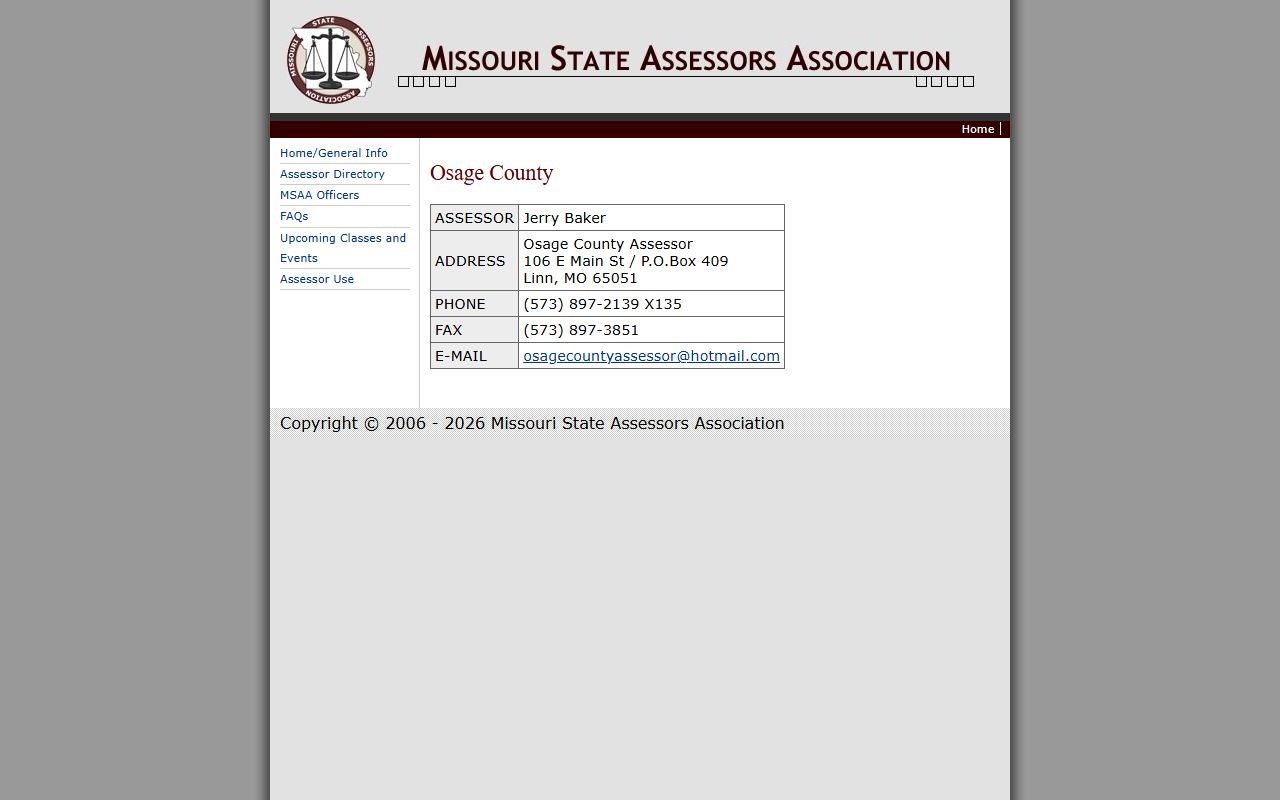
The Osage County Assessor has a dedicated online search tool at osagecountyassessor.com. Ed Quinton Jr serves as the assessor. The office is at 205 E Main St, PO Box 409, Linn, MO 65051. You can search real estate records by owner name, physical address, account numbers, or cadastral data. The site is free to use and open to the public.
The assessor's office also has interactive mapping. You can click on a parcel to see tax data, assessed values, and owner details on a map. The office staff includes Deputy Assessor Cory Dudenhoeffer, Senior Clerical Ashley Starke, and Clerical Vickie Huckstep. The office is open Monday through Friday, 8:00 a.m. to 4:30 p.m. Call 573-897-2217 ext 135 for assistance.

Real estate data mailing lists are available at $0.25 per parcel. The office also handles ag permit cards and renewals.
Under RSMo 137.115, residential property is assessed at 19% of market value. Commercial uses 32%, and agricultural land is at 12% of productivity value. Personal property is at 33 1/3%. Real property gets reassessed in odd-numbered years.
Osage County Tax Collection and Payments
The Osage County Collector of Revenue is at 205 E Main, PO Box 616, Linn, MO 65051. Call 573-897-2135 ext 120 for questions about your tax bill. The collector handles all real estate and personal property tax payments for the county. Tax bills are mailed in the fall and due by December 31 each year.
Personal property taxes in Osage County are based on the vehicles you own as of January 1 of the current year. You must report all taxable personal property to the assessor's office no later than March 1. If you are a new resident, contact the assessor right away. If you moved from another Missouri county, notify your previous county assessor as well. You still pay taxes in the prior county if you lived there on January 1.
Visit the Osage County official website for links to all county offices, including the collector and assessor.

Note: Late assessment penalties range from $15 to $105 under RSMo 137.280.
Appealing Osage County Property Tax Values
If you disagree with the assessed value on your property, start by contacting the assessor's office for an informal review. The assessor's links and resources page includes connections to the Missouri State Tax Commission and the Missouri Assessors Association for more help with the process.
If the informal talk does not resolve things, file with the Board of Equalization by the second Monday in July. The board hears cases from property owners who think their values are wrong. Bring comparable sales or a recent appraisal. If the board sides with the assessor, you can appeal to the State Tax Commission by September 30. This process is free for residential properties.
Osage County Tax Records Resources
The county treasurer is at PO Box 573, Linn, phone 573-897-3095. The county clerk is at PO Box 826, phone 573-897-2139. The recorder of deeds is at PO Box 110, phone 573-897-3095 ext 145. All offices are in Linn. The Missouri Counties page for Osage County has a full directory.
Missouri offers a Property Tax Credit through the Missouri Department of Revenue. The maximum credit is $1,100 for homeowners who qualify. Tax sales for delinquent properties happen once a year under Chapter 140 of the Missouri Revised Statutes. Contact the collector for exact dates and rules for Osage County tax sales.
Osage County is in central Missouri. The county has a mix of farm land, residential areas, and small towns. Most parcels fall under the agricultural or residential assessment rates set by state law.